Battery Energy Storage Systems
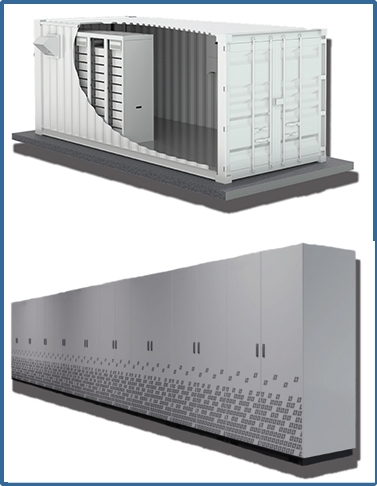
As power demands increase and organizations look for greater control over energy costs and resilience, Battery Energy Storage Systems (BESS) provide another option for managing how and when power is used.
JEM Tech Group helps organizations evaluate and integrate battery energy storage as part of a broader power infrastructure strategy, alongside UPS systems, generators, power distribution and monitoring.
Discuss Your BESS Requirements
What Are Battery Energy Storage Systems?
A Battery Energy Storage System (BESS) stores electrical energy so it can be used when it is needed rather than only when it is generated or supplied by the utility. BESS can help organizations manage peak demand, support critical loads, improve energy resilience and integrate renewable energy sources.
Unlike traditional backup power systems designed primarily for outages, BESS can also be used strategically during normal operations to manage when grid power is consumed.
Why Organizations Are Considering Battery Energy Storage
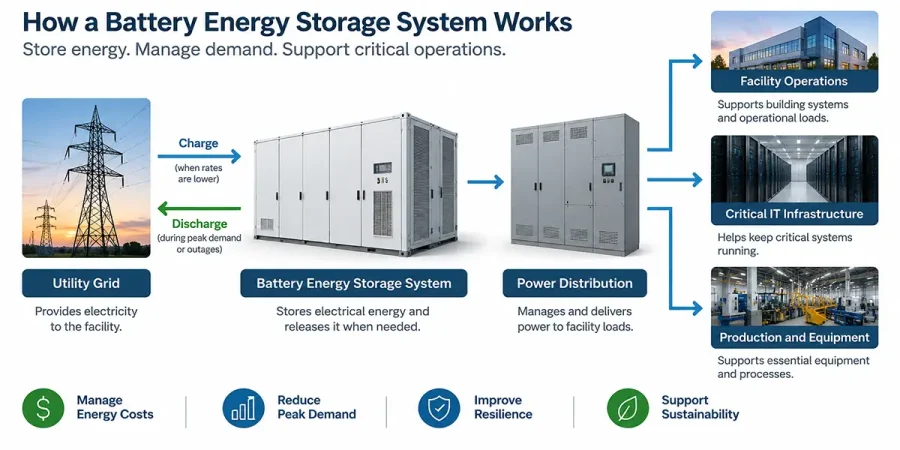
How a Battery Energy Storage System stores energy and delivers it to facility loads when needed.
Energy requirements are changing. Facilities are supporting growing electrical loads while also facing concerns around utility costs, grid reliability, resilience and long-term capacity.
Battery energy storage can provide organizations with greater flexibility in how energy is stored and used.
Potential benefits include:
– Peak Demand Management: Store energy during lower-demand periods and use it when demand increases.
– Energy Cost Management: Reduce reliance on utility power during higher-cost periods where rate structures make this beneficial.
– Power Resilience: Provide stored energy to support critical operations during utility interruptions or other power events.
– Renewable Energy Integration: Store energy produced by solar or other renewable sources for use when it is needed.
– Energy Flexibility: Give facilities greater control over when and how stored energy is used.
– Infrastructure Planning: Support changing power requirements as facilities add new equipment, technology and electrical loads.
Common Uses for Battery Energy Storage Systems
BESS can support a variety of energy and power strategies depending on the facility, utility structure and operational requirements.
Peak Demand Management
Facilities can discharge stored energy during periods of high electrical demand, helping reduce the amount of power drawn from the utility during peak periods.
Backup and Resilience
Stored energy can provide additional power support during utility disruptions and can be incorporated into a broader resilience strategy alongside UPS systems and generators.
Energy Cost Management
Where utility rate structures allow, organizations can store energy when electricity costs are lower and use that energy during more expensive periods.
Solor and Microgrid Integration
Battery storage can capture excess energy generated by solar or other distributed energy resources and make that energy available when generation is reduced or demand increases.
Support for Changing Power Requirements
As organizations add higher-density technology, automation, electrification and other new loads, BESS can be evaluated as part of a broader strategy for managing power capacity and resilience.
When Does Battery Energy Storage Make Sense?
Battery energy storage may be worth evaluating when an organization is looking to improve energy resilience, manage increasing power demands or gain greater control over how and when utility power is used.
BESS may be appropriate for facilities that:
– Experience significant peak demand charges
– Need additional resilience for critical operations
– Want to reduce reliance on generators during certain operating conditions
– Are integrating solar, microgrids or other distribued energy resources
– Need extended power support beyond traditional short-duration backup
– Are adding higher-density technology or electrical loads
– Want greater visibility and control over energy use
The right solution depends on the facility’s load profile, required runtime, existing electrical infrastructure, utility rate structure and operational requirements.
Where Battery Energy Storage Systems Are Used
Battery energy storage can support a wide range of organizations and critical environments. The application and system requirements will vary based on operational priorities, electrical loads, resilience requirements and energy-management goals.
Federal Government
BESS can support federal and government facilities where energy resilience, operational continuity and reliable power are critical. Applications may include data centers, telecommunications infrastructure, command and control environments, research and laboratory facilities, remote sites and other mission-critical operations.
Data Centers and Technology
Battery energy storage can complement UPS, generator and power distribution infrastructure supporting data centers, higher-density computing, telecommunications environments and edge infrastructure. BESS may also provide additional options for managing changing power requirements and energy demand.
Manufacturing and Industrial
Manufacturing facilities can evaluate BESS to support critical processes, automation, production environments and facilities with significant or fluctuating electrical demand. Stored energy can also become part of a broader strategy for resilience and energy cost management.
Education
Higher education and K-12 facilities can use battery energy storage to support critical IT infrastructure, telecommunications, research facilities, operational systems and broader facility energy requirements.
Healthcare
Healthcare organizations depend on resilient infrastructure to support critical technology and operations. BESS can be evaluated alongside existing backup power and electrical infrastructure as part of a broader energy resilience strategy.
Utilities and Energy
Utilities and energy organizations can use battery storage to support operational technology, control environments, remote infrastructure, distributed energy resources and other applications requiring greater flexibility in how energy is stored and used.
Retail and Distributed Facilities
Organizations operating multiple or distributed locations can evaluate BESS for critical technology infrastructure, energy-management requirements, resilience and facilities experiencing changing electrical demands.
Other Commercial and Critical Facilities
BESS can also support commercial buildings and other critical facilities seeking greater energy resilience, additional power capacity or greater control over how and when energy is consumed.
BESS as Part of a Mission-Critical Power Strategy
For environments where an interruption can affect technology, operations, production, communications, research or safety, battery energy storage should be considered within the context of the entire power infrastructure.
BESS may complement existing UPS systems, generators, power distribution, monitoring and controls while providing additional options for energy management, capacity and resilience.
The appropriate strategy depends on the critical loads being supported, required runtime, existing infrastructure and the organization’s operational requirements.
BESS vs. UPS vs. Generator: What’s the difference?
Battery energy storage, UPS systems and generators can all contribute to power resilience, but they serve different purposes.
A UPS provides immediate power protection when utility power is interrupted and helps protect critical equipment from power disturbances.
A generator provides longer-duration backup power by producing electricity when utility power is unavailable.
A Battery Energy Storage System stores energy that can be used for backup power as well as broader energy-management applications, including peak demand management and integration with renewable energy sources.
These technologies do not necessarily replace one another. Depending on the application, BESS, UPS and generator systems can work together as part of a coordinated power infrastructure strategy.
Lithium Iron Phosphate Battery Technology
Lithium Iron Phosphate (LFP) is one battery chemistry used in modern battery energy storage systems. LFP technology is often considered for stationary energy storage applications because of its cycle life, thermal characteristics and ability to support repeated charging and discharging.
Battery chemistry is only one consideration when evaluating a BESS. System capacity, power requirements, runtime, controls, installation environment, safety requirements and integration with existing infrastructure must also be considered when selecting a solution.
What Should You Consider Before Implementing BESS?
Battery energy storage should be evaluated as part of the facility’s overall electrical and operational environment. Important considerations include:
Load Profile and Capacity Requirements
How much power needs to be supported, when does demand occur and how long must stored energy be available? Understanding the facility’s load profile is fundamental to determining appropriate system capacity.
Existing Power Infrastructure
BESS may need to interact with UPS systems, generators, switchgear, power distribution and other electrical infrastructure. Existing equipment and system architecture should be evaluated before determining how energy storage fits into the environment.
Primary Objective
The system should be designed around the organization’s goals. These may include resilience, peak demand management, energy cost management, renewable integration, capacity planning or a combination of objectives.
Installation Environment
Available space, environmental conditions, equipment location, cooling, access and other site requirements can influence system design and installation.
Monitoring and Controls
Operators need visibility into system status, battery capacity, alarms and performance. Monitoring and controls should be considered as part of the overall BESS strategy rather than as an afterthought.
Safety and Compliance
Battery energy storage installations must account for applicable electrical, fire, building and safety requirements as well as manufacturer specifications. Requirements vary based on system design, capacity, application and location.
Why JEM Tech Group for Battery Energy Storage?
Battery energy storage does not operate in isolation. It must work with the facility’s existing electrical infrastructure, critical loads, backup power systems, monitoring and operational requirements.
For nearly 50 years, JEM Tech Group has helped organizations assess, design, implement and manage the physical infrastructure that keeps critical technology and operations running.
Our vendor-neutral approach allows us to evaluate BESS as part of the broader power environment, including UPS systems, generators, power distribution and monitoring, helping organizations determine what fits their requirements today while preparing for what comes next.
Supporting Commercial and Federal Requirements
JEM supports organizations across commercial, industrial, education, healthcare, utility and government environments. For federal customers, JEM is a Woman-Owned Small Business (WOSB) and offers access to solutions through our GSA contract.
Product-specific federal requirements, including TAA compliance, can be evaluated based on the selected solution and procurement requirements.
Explore JEM’s Federal Capabilities
Battery Energy Storage FAQs
What is a Battery Energy Storage System?
A Battery Energy Storage System stores electrical energy for later use. Depending on the application, stored energy can be used to support critical loads, manage peak demand, reduce exposure to higher utility rates or support renewable energy and microgrid strategies.
How does a BESS work?
A BESS charges by storing electrical energy in batteries and discharges that stored energy when it is needed. Controls determine when the system charges and discharges based on the application, facility requirements and operating strategy.
What is the difference between BESS and UPS?
A UPS is primarily designed to provide immediate power protection for critical equipment during an interruption or power-quality event. BESS can provide stored energy for a broader range of applications, including energy management, peak demand management and resilience. Depending on the facility, the two technologies can be used together.
Can BESS work with an existing generator?
Yes. Battery energy storage can be incorporated into power architectures that also include generators. The appropriate configuration depends on the facility’s electrical system, critical loads, runtime requirements and operating strategy.
Can BESS help reduce peak demand charges?
Potentially. A BESS can discharge stored energy during periods of high facility demand, reducing the amount of electricity being drawn from the utility. The financial benefit depends on the facility’s load profile and utility rate structure.
How long can a Battery Energy Storage System provide power?
There is no single runtime for BESS. Runtime depends on battery capacity, the amount of load being supported, system design and the intended application. Proper sizing begins with understanding the facility’s load profile and required duration.
Can BESS integrate with solar or a microgrid?
Yes. Battery energy storage can store energy generated by solar or other distributed energy resources and make that energy available when generation decreases or facility demand increases. BESS can also be incorporated into broader microgrid strategies.
Is Battery Energy Storage Right for Your Environment?
Every facility has different power requirements. JEM Tech Group can help evaluate your existing infrastructure, critical loads, resilience goals and energy requirements to determine where battery energy storage may fit within your broader power strategy.