Manufacturing & Industrial IT Infrastructure
Supporting Smart Manufacturing, AI, and Industry 4.0
Across the industry, manufacturing operations are changing. At the same time, artificial intelligence (AI), machine learning, robotics, and industrial automation are transforming production processes, improving operational visibility, and enabling more intelligent decision-making.
As manufacturers adopt these technologies, the demands on their physical IT infrastructure are changing. As a result, increased computing densities, higher power consumption, growing heat loads, and expanding edge computing requirements are placing new pressures on facilities and systems that may not have been designed for them.
JEM Tech Group helps manufacturers evaluate, modernize, and prepare the physical IT infrastructure that supports connected operations, from plant-floor edge environments to centralized data centers.
Discuss Your Manufacturing Infrastructure
Smart Manufacturing Is Changing Infrastructure Requirements
Industry 4.0 Requires More Than Connected Equipment

For instance, smart manufacturing integrates connected machinery, Industrial Internet of Things (IIoT) devices, advanced analytics, AI, and machine learning to improve production efficiency and operational decision-making.
In turn, these technologies depend on reliable computing, networking, and supporting infrastructure throughout production facilities.
As a result, applications such as machine vision, predictive maintenance, digital twins, and automated quality inspection can introduce new demands on power, cooling, equipment capacity, and infrastructure availability.
Not all workloads create the same requirements.
AI and High-Density Computing
For example, centralized AI workloads, engineering simulations, and compute-intensive applications can require significantly greater rack power and cooling capacity than traditional enterprise IT equipment.
Industrial Edge Computing
In particular, machine vision, real-time analytics, and localized AI inference often require computing resources closer to production equipment. Because of these conditions, these systems need reliable power, environmental protection, and appropriate thermal management in spaces that may not resemble traditional IT rooms.
Connected Manufacturing Operations
As facilities connect more equipment and systems, reliable network infrastructure, monitoring, and remote access become increasingly important to maintaining operational visibility and supporting distributed IT environments. Consequently, manufacturers must consider whether their existing infrastructure can accommodate future expansion.
Infrastructure Challenges Facing Manufacturers
Where Modern Manufacturing Places New Demands on IT
1. Power Reliability and Production Continuity
For example, unexpected power interruptions and infrastructure failures can affect the systems supporting manufacturing operations.
To reduce these risks, manufacturers can use UPS systems, resilient power distribution, and power monitoring to help protect critical IT equipment and improve infrastructure reliability.
2. Higher Computing Densities and Cooling Demands
As computing capacity increases, traditional cooling configurations may struggle to manage additional heat loads.
Therefore, evaluating rack densities, airflow, thermal conditions, and cooling capacity helps manufacturers identify limitations before introducing new equipment.
3. Limited Space and Aging Infrastructure
In many cases, manufacturing facilities operate with IT rooms, network closets, and equipment areas designed for earlier generations of technology.
Therefore, expanding computing capacity may require more efficient equipment layouts, higher-density power distribution, or alternative infrastructure configurations.
4. Harsh Plant-Floor Conditions
For example, dust, vibration, temperature fluctuations, humidity, and restricted physical access can affect the reliability of computing and network equipment.
To address these conditions, manufacturers can use industrial enclosures, localized cooling, environmental monitoring, and appropriate equipment protection.
5. Limited Infrastructure Visibility
As a result, distributed manufacturing environments can make it difficult to understand available power capacity, thermal conditions, and infrastructure performance across multiple locations.
With centralized monitoring and infrastructure management tools, manufacturers can identify developing issues and make more informed capacity planning decisions.
6. Modernization Without Production Disruption
Meanwhile, infrastructure improvements often need to occur while production continues.
Through assessments, coordinated planning, and phased implementation, manufacturers can address infrastructure requirements while minimizing interference with daily operations.
Infrastructure Solutions for Manufacturing & Industrial Facilities
Supporting Reliability, Efficiency, and Future Growth
JEM Tech Group provides vendor-neutral infrastructure solutions designed around each facility’s operational requirements, existing conditions, and long-term technology plans.
Critical Power & Power Distribution
For this reason, reliable power infrastructure is essential to the computing and network equipment behind modern manufacturing operations.
In addition, JEM helps organizations evaluate UPS systems, intelligent rack PDUs, power distribution, busway, and power monitoring technologies.
Together, these technologies support equipment protection, capacity visibility, and more effective use of available electrical infrastructure.
Cooling, Airflow & Thermal Management
As equipment density increases, thermal demands in manufacturing IT environments can rise.
Depending on the application, JEM supports precision cooling, in-row cooling, rear-door heat exchangers, liquid cooling, airflow management, and thermal monitoring.
Before expanding computing capacity, evaluating existing conditions helps determine whether traditional cooling remains appropriate or alternative approaches are needed.
Industrial Edge & Micro Data Centers
For example, manufacturers increasingly deploy computing and networking equipment closer to production processes.
For this purpose, industrial edge enclosures and micro data centers can provide protected environments with integrated power, cooling, monitoring, and physical security.
As a result, manufacturers can support localized computing in production areas where conventional data center infrastructure may not be practical.
DCIM & Environmental Monitoring
As equipment becomes more distributed across facilities, infrastructure visibility becomes increasingly important.
For example, DCIM software, environmental sensors, power monitoring, and thermal analytics help organizations monitor infrastructure conditions, identify potential problems, and evaluate available capacity.
With better visibility into infrastructure conditions, IT and facilities teams can make more informed maintenance and planning decisions.
Racks, Enclosures & Physical Infrastructure
Industrial IT equipment must be protected and organized within the environments where it operates.
To meet these requirements, JEM offers rack systems, industrial enclosures, cable management, physical access controls, and related infrastructure designed for equipment density, operating conditions, and facility requirements.
Remote Access & Out-of-Band Management
In addition, distributed facilities often require IT teams to support equipment without being physically present.
Out-of-band management, serial console access, and remote KVM solutions provide alternative methods for accessing and troubleshooting supported infrastructure.
As a result, these technologies can reduce the need for on-site troubleshooting and improve IT infrastructure support across multiple manufacturing locations.
Manufacturing Environments We Support
Infrastructure requirements vary across a manufacturing operation. JEM supports physical IT environments including:
– Production Floors & Industrial Edge: Protected infrastructure supporting localized computing, automation-related systems, and connected equipment.
– Manufacturing Data Centers & Server Rooms: Power, cooling, monitoring, and physical infrastructure supporting enterprise applications and compute-intensive workloads.
– MDF/IDF & Telecommunications Rooms: Reliable power, environmental management, and equipment organization supporting facility connectivity.
– Operations & Control Rooms: Physical infrastructure and command-and-control environments supporting production oversight and operational coordination.
– Engineering, Research & Testing Facilities: Infrastructure supporting simulation, product development, and high-performance computing.
– Warehousing & Distribution Areas: Distributed IT infrastructure supporting connected logistics, inventory systems, and automated material handling.
Preparing Manufacturing Infrastructure for What’s Next
Plan for Tomorrow’s Technology Without Overlooking Today’s Limitations
As manufacturers continue investing in AI, machine learning, robotics, and advanced automation, supporting infrastructure must be evaluated alongside technology plans.
First, manufacturers need to understand what their existing infrastructure can support and identify where additional capacity or alternative approaches may be needed.
Important considerations include:
– Power Capacity: Can existing electrical distribution and backup power systems support additional computing equipment?
– Cooling Performance: Are current cooling systems capable of managing anticipated heat loads?
– Equipment Density: Can existing racks and IT spaces accommodate future computing requirements?
– Edge Expansion: Are production-floor environments equipped to support additional computing and network infrastructure?
– Infrastructure Visibility: Can IT and facilities teams monitor conditions and identify capacity constraints across locations?
– Scalability: Can infrastructure be expanded or reconfigured as technology requirements change?
Preparing for the future does not necessarily require replacing existing systems. Instead, understanding current capacity and identifying targeted improvements can help organizations make better use of their infrastructure investments.
Manufacturing Infrastructure in Practice
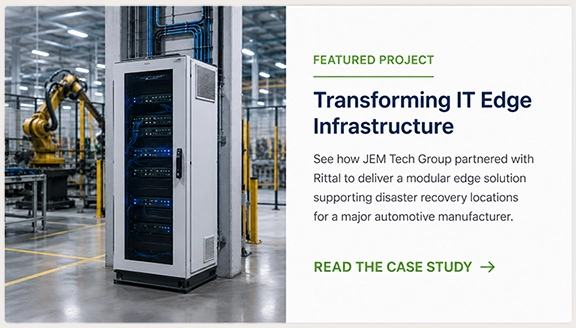
Supporting Edge Computing for an Automotive Supplier
Modern automotive manufacturing increasingly relies on connected equipment, localized computing, and reliable data processing.
Industrial edge infrastructure can provide protected, scalable environments for computing equipment located near production operations.
Featured Resource: Automotive Supplier Edge Infrastructure Case Study
Why JEM Tech Group?
Experience Supporting Mission-Critical Infrastructure
For nearly 50 years, JEM Tech Group has helped organizations address the physical infrastructure requirements of critical IT environments.
Rather than relying on a single manufacturer, our vendor-neutral approach focuses on matching infrastructure technologies to operational requirements, facility conditions, and future capacity needs.
What manufacturers can expect:
– Vendor-Neutral Expertise: Infrastructure options evaluated around application requirements rather than a single manufacturer’s portfolio.
– Broad Infrastructure Capabilities: Power, cooling, monitoring, racks, enclosures, edge infrastructure, and remote access.
– Support Across Facility Environments: Solutions for data centers, telecommunications rooms, plant floors, distributed locations, and control rooms.
– Future-Focused Planning: Infrastructure considerations for AI, higher-density computing, automation, and emerging technologies.
– Project Support: Assistance with assessments, planning, solution selection, and implementation coordination through qualified partners when needed.
Our focus is helping manufacturers maintain reliable operations while preparing their infrastructure for changing technology requirements.
Frequently Asked Questions
How is Industry 4.0 changing manufacturing IT infrastructure?
Industry 4.0 connects production equipment, sensors, computing systems, and analytics to enable more intelligent manufacturing operations. As a result, these technologies can increase demands on computing capacity, power distribution, cooling, network infrastructure, and environmental monitoring.
How does AI affect power and cooling requirements in manufacturing facilities?
AI applications can introduce additional computing workloads that increase electrical consumption and heat generation. However, requirements vary depending on the equipment and whether workloads run at the edge or in centralized computing environments. Therefore, manufacturers should evaluate existing power and cooling capacity before expanding these systems.
Why is industrial edge computing important for manufacturing?
Industrial edge computing processes information closer to production equipment. As a result, it can reduce latency and support applications requiring timely local data processing. Edge infrastructure provides the physical protection, power, cooling, and monitoring needed to support computing equipment outside traditional data centers.
How can manufacturers reduce IT infrastructure-related downtime?
Manufacturers can reduce infrastructure-related downtime risks by evaluating power protection, cooling performance, environmental conditions, equipment capacity, and monitoring capabilities. In addition, regular assessments and proactive maintenance can help identify potential problems before they affect operations.
What infrastructure should manufacturers evaluate before increasing computing density?
Manufacturers should review electrical capacity, UPS requirements, rack power distribution, cooling performance, airflow, equipment layout, and monitoring. Consequently, higher-density deployments may require changes to power distribution or cooling strategies.
Can existing manufacturing facilities support AI and automation expansion?
Many facilities can support additional computing equipment, but readiness depends on existing infrastructure capacity, operating conditions, and future workload requirements. An assessment can help determine whether current systems are sufficient or targeted upgrades are needed.
Related Infrastructure Solutions
Explore the technologies supporting modern manufacturing operations:
– Industrial Edge & Micro Data Centers
– Critical Power & Power Distribution
– Cooling & Thermal Management
– Data Center Infrastructure Management
– Continuous Thermal Monitoring
– MDF/IDF Infrastructure
– Out-of-Band Management
Is Your Manufacturing Infrastructure Ready for What’s Next?
Whether you’re expanding automation, introducing AI-enabled applications, increasing computing density, or modernizing an existing facility, understanding your infrastructure’s capabilities is an important first step.
From there, JEM Tech Group can help assess current conditions, identify potential limitations, and explore infrastructure approaches that support both immediate operational requirements and future technology plans.
Discuss Your Manufacturing Infrastructure


