The capacity you may be overlooking. The infrastructure knowledge you can’t afford to lose.
What if your existing IT infrastructure could support more than you realize? Or what if the person who knows your infrastructure best was suddenly unavailable?
These challenges can affect operations, budgets, and future projects, often before organizations recognize the risks.
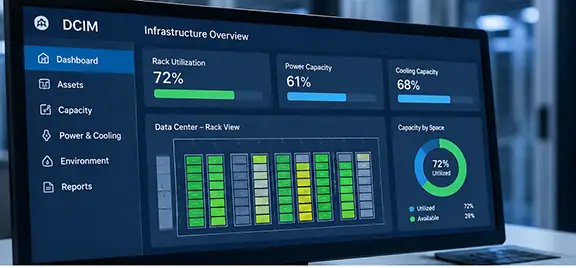
Data Center Asset Management and DCIM Visibility
Modern Data Center Infrastructure Management (DCIM) software does more than track equipment. It helps organizations understand infrastructure connections, monitor resource utilization, and plan for future capacity needs.
The goal isn’t simply better visibility. It’s making better decisions with the infrastructure you already own.
Explore What’s Possible with Your Infrastructure
Are You Overlooking Capacity You Already Own?
Before investing in additional infrastructure, how confident are you that your existing resources are being fully utilized?
A data center may have available rack space but insufficient power to support additional equipment. Another area may have adequate power capacity that cannot be effectively used because of distribution or cooling constraints.
These situations can create stranded capacity, where existing resources are available but cannot be fully utilized.
Without accurate infrastructure information, organizations may purchase additional equipment, expand facilities, or delay projects without understanding all their options.
How DCIM Helps You Make Better Use of Existing Infrastructure
Depending on the platform and available monitoring data, DCIM software can help organizations:
– Identify underutilized resources. Understand available rack space, power, cooling, and connectivity.
– Improve capacity planning. Evaluate current utilization and future requirements before adding equipment.
– Model infrastructure changes. Assess how proposed equipment additions or changes could affect available capacity.
– Support investment decisions. Determine whether existing infrastructure can accommodate new requirements before expanding.
– Improve resource allocation. Identify opportunities to redistribute equipment within physical infrastructure constraints.
Are you planning your next infrastructure investment based on actual requirements or incomplete information about available capacity?
Better infrastructure intelligence can help organizations make that distinction.
Is Your Infrastructure Ready for Higher-Density Workloads?
Advances in artificial intelligence (AI), machine learning, high-performance computing (HPC), and other compute-intensive technologies are driving demand for higher-density IT infrastructure. These workloads can place greater demands on power distribution, cooling, and available capacity.
As rack densities increase, understanding existing infrastructure limitations becomes increasingly important. Available rack space alone doesn’t guarantee that an environment can support additional equipment.
Before investing in upgrades, organizations need to understand what their existing infrastructure can support and where improvements may be required.
Depending on the platform and available data, DCIM solutions can help organizations:
– Evaluate power capacity. Identify available capacity and distribution constraints before deploying higher-density equipment.
– Understand cooling limitations. Use environmental monitoring and capacity information to identify potential constraints.
– Plan infrastructure changes. Evaluate how equipment additions may affect existing power, cooling, and space resources.
– Prepare for future requirements. Support infrastructure planning as computing demands evolve.
DCIM provides valuable infrastructure visibility, but it doesn’t replace electrical assessments, thermal analysis, or detailed engineering. Together, these capabilities help organizations make informed decisions about supporting higher-density environments.
Understanding today’s infrastructure is an important step toward supporting tomorrow’s technology requirements.
What Happens When Infrastructure Knowledge Walks Out the Door?

Accurate infrastructure documentation helps preserve critical operational knowledge.
Every organization has someone who knows the environment better than anyone else.
They know which equipment is connected, where the spare capacity exists, what changed during the last upgrade, and which systems depend on one another.
But what happens when that person retires, changes positions, or isn’t available when something goes wrong?
Critical infrastructure knowledge often exists across spreadsheets, diagrams, maintenance records, and individual experience.
When documentation is incomplete or outdated, routine maintenance and infrastructure changes can become more difficult.
How DCIM Helps Preserve Critical Infrastructure Knowledge
A well-maintained DCIM platform can provide a centralized source of physical infrastructure information, helping organizations:
– Document physical assets. Maintain equipment records, locations, configurations, and ownership.
– Map infrastructure dependencies. Understand how equipment connects to power and network infrastructure.
– Track changes. Maintain records of equipment additions, moves, and removals.
– Improve collaboration. Give authorized personnel access to consistent infrastructure information.
– Support operational continuity. Reduce dependence on individual employees for essential infrastructure details.
DCIM doesn’t replace experienced personnel. It provides a structured way to document, maintain, and share the information teams need to manage their environments.
If your most experienced infrastructure employee left tomorrow, would the rest of your team have the information needed to keep operations moving?
Critical infrastructure knowledge should remain accessible to the organization, regardless of who is available.
Beyond Asset Tracking: What Can Modern DCIM Actually Do?
Data Center Infrastructure Management software helps organizations document, manage, and, depending on the platform, monitor the physical infrastructure supporting critical IT operations.
While capabilities vary by solution, DCIM platforms may support:
Asset and Connectivity Management
Maintain centralized records of physical IT assets, including equipment locations, configurations, and power or network connections.
Capacity Planning and Forecasting
Evaluate available rack space, power, cooling, and connectivity to support current operations and future infrastructure requirements.
Power and Environmental Monitoring
Monitor power consumption, temperature, humidity, and other environmental conditions through compatible equipment and sensors.
Infrastructure Visualization
Use rack elevations, floor plans, and dashboards to understand physical infrastructure relationships and operating conditions.
Change Management
Document planned and completed infrastructure changes to improve coordination and maintain accurate records.
Reporting and Analysis
Analyze infrastructure data to identify trends, support planning, and evaluate opportunities for greater efficiency.
The value of DCIM isn’t simply collecting more data. It’s understanding what that data means for your operations.
Choosing the Right DCIM Solution for Your Environment
Not every organization needs the same level of infrastructure management.
Some facilities need reliable asset tracking and connectivity documentation. Others require capacity forecasting, power monitoring, environmental visibility, or centralized oversight across multiple locations.
The right DCIM approach depends on several factors:
– Size, complexity, and number of locations
– Existing infrastructure and monitoring systems
– Accuracy of current asset documentation
– Capacity planning and reporting requirements
– Integration with existing operational tools
– Scalability and future high-density infrastructure requirements
Selecting DCIM software should begin with understanding the operational challenges it needs to solve, rather than comparing feature lists alone.
Why Work with JEM Tech Group?
For nearly 50 years, JEM has helped organizations assess, design, implement, and maintain mission-critical physical IT infrastructure.
As a Michigan-based, certified woman-owned small business, JEM takes a vendor-neutral approach to infrastructure planning and optimization.
Our experience spans critical power, cooling, racks and enclosures, environmental monitoring, edge infrastructure, and command and control environments.
We understand that DCIM software is only one part of an effective infrastructure management strategy.
Accurate asset records, reliable monitoring data, physical infrastructure constraints, and operational requirements all influence the success of a DCIM implementation.
JEM helps organizations evaluate DCIM solutions that improve infrastructure visibility, support power and cooling decisions, and prepare for evolving requirements, including AI and higher-density workloads.
Frequently Asked Questions About DCIM
What is data center asset management?
Data center asset management involves tracking and maintaining information about physical IT equipment, including location, configuration, ownership, connectivity, and lifecycle. DCIM software can centralize these records and connect them with other infrastructure management functions.
What is the difference between DCIM and asset management?
Asset management focuses primarily on equipment inventory and related records. DCIM offers broader capabilities, which may include capacity planning, connectivity mapping, infrastructure monitoring, visualization, and change management.
Can DCIM help reduce infrastructure costs?
DCIM can help identify underutilized resources, improve capacity planning, and evaluate existing infrastructure before additional investments are made. Actual savings depend on the environment, available data, and operational decisions.
What is stranded capacity in a data center?
Stranded capacity is infrastructure capacity that exists but cannot be effectively used because of physical, technical, or operational constraints. DCIM tools can help identify available resources and determine whether they can support additional equipment.
How does DCIM help preserve institutional knowledge?
DCIM provides a centralized system for documenting physical assets, equipment connections, and infrastructure changes. Accurate, regularly maintained records reduce reliance on individual employees and support continuity when personnel change.
Can DCIM manage multiple locations?
Many DCIM platforms support centralized management of multiple data centers, network rooms, and distributed IT environments. Specific capabilities depend on the software and infrastructure being monitored.
What Could Your Infrastructure Be Telling You?
You may have more usable capacity than you realize. You may also have critical infrastructure knowledge that isn’t adequately documented.
Either situation can affect how confidently your organization plans, invests, and responds to change.
What would better infrastructure intelligence reveal about your environment?
JEM Tech Group can help you identify infrastructure management challenges and evaluate solutions that align with your operational needs.
Discuss Your Infrastructure Challenges
Mission Critical Infrastructure That Supports What’s Next.


