Data Center Maintenance: What to Check as Seasons Change
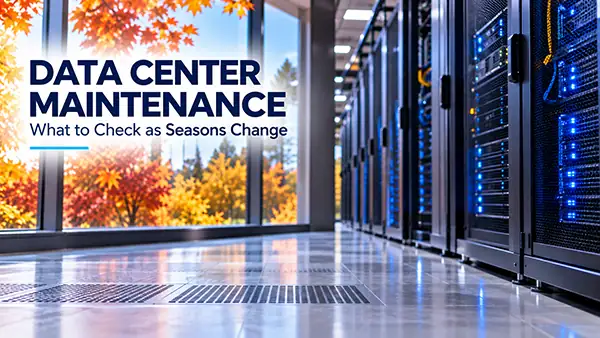 Data center maintenance is essential year-round, but changing seasons provide a natural opportunity to take a closer look at the infrastructure supporting your IT environment.
As outdoor temperatures and humidity levels change, cooling requirements and environmental conditions can change as well. At the same time, your IT equipment continues generating heat 24/7.
Fall is a good time to review your data center’s power, cooling, airflow and environmental monitoring to identify potential issues, improve efficiency and make sure critical infrastructure is prepared for the months ahead.
1. Review Data Center Cooling Performance
Cooler weather outside does not necessarily mean your data center needs less attention.
IT equipment continues to generate heat regardless of outdoor conditions, making effective cooling essential throughout the year. However, lower outdoor temperatures may create opportunities for some facilities to use economization or free cooling strategies to reduce mechanical cooling requirements.
JEM supports a variety of cooling approaches, including free cooling, perimeter, in-row, in-rack, rear-door heat exchangers, and other cooling solutions based on the requirements of the environment.
Maintenance considerations:
– Check cooling equipment performance
– Inspect and replace filters as needed
– Review temperature setpoints
– Look for unexpected hot spots
– Verify cooling redundancy
– Review alarms and notifications
The goal is not simply to add more cooling. It is to make sure the cooling already available is being used effectively.
2. Check Airflow Throughout the Data Center
Cooling and airflow go hand in hand.
Poor airflow can cause conditioned air to bypass IT equipment, allow hot and cold air to mix, and create localized hot spots. These conditions can make cooling systems work harder than necessary.
A data center maintenance review should include the racks and the room itself.
Look for missing blanking panels, unmanaged cable openings, obstructions, poor cable management, and other conditions that can interfere with airflow.
Airflow management solutions such as hot and cold aisle containment, rack hygiene, blanking panels, raised-floor grommets and underfloor airflow management can help conditioned air reach the equipment that needs it.
Related Resource: Airflow Management
3. Monitor Temperature and Humidity
A room-level thermostat only tells part of the story.
ASHRAE provides recommended environmental ranges for data center IT equipment to help balance equipment reliability with energy efficiency.
Conditions can vary significantly throughout a data center, particularly at different racks and elevations. Environmental monitoring can provide greater visibility into temperature, humidity, airflow, and other conditions that could affect IT equipment.
JEM’s monitoring capabilities include environmental monitoring as part of its broader critical facility management and monitoring portfolio.
As seasons change, review:
– Temperature and humidity readings
– Sensor placement
– Alert thresholds
– Historical trends
– Unusual environmental changes
– Areas experiencing recurring hot spots
Monitoring conditions over time can also help determine whether changes to cooling or airflow are actually improving the environment.
4. Inspect UPS and Backup Power Systems
Cooling may be the obvious seasonal consideration, but data center maintenance should not stop there.
Power infrastructure is fundamental to maintaining uptime. UPS systems, batteries, generators, and other backup power equipment should be maintained according to manufacturer recommendations and the requirements of the facility.
JEM’s equipment maintenance capabilities include power and cooling maintenance, UPS and generator maintenance, battery replacement, battery monitoring, and extended warranties.
A maintenance review can include checking:
– UPS operating condition
– Battery health and age
– Generator readiness
– Power distribution equipment
– Alarm conditions
– Maintenance records
– Redundancy and failover procedures
Having redundant infrastructure is valuable, but only when the backup systems are ready to perform when needed.
5. Review Environmental Monitoring and Alarms
Temperature and humidity are not the only environmental conditions worth monitoring.
Depending on the facility, monitoring may also include water leaks, airflow, air pressure, particles, vibration, and other physical environmental threats.
Maintenance should include confirming that sensors are functioning, alerts are reaching the correct people, and response procedures are still appropriate.
This is particularly important as facilities, equipment, and personnel change over time.
6. Look at What’s Changed
One of the most valuable parts of data center maintenance is simply asking:
What has changed since the last time we evaluated this environment?
New equipment may have been added. Rack densities may have increased. Cables may have accumulated. Workloads may have shifted. Cooling requirements may be different. Capacity that was sufficient several years ago may no longer match current requirements.
A critical infrastructure assessment can help identify potential limitations in areas such as cooling, capacity, redundancy, and thermal performance. JEM’s assessment capabilities include CFD modeling, PUE studies, redundancy, and failure analysis, thermal load analysis, energy audits, and capacity planning.
Data Center Maintenance Checklist
As you review your environment, consider these key areas:
– Power: UPS, batteries, generators and power distribution
– Cooling: Equipment performance, filters, setpoints and redundancy
– Airflow: Containment, blanking panels, cable openings and obstructions
– Environment: Temperature, humidity, leak detection and other sensors
– Monitoring: Alerts, thresholds, trends and notifications
– Racks: Cable management, equipment placement and available capacity
– Documentation: Maintenance records, asset information and procedures
– Capacity: Changes in power, cooling, space and rack density
Regular data center maintenance can help uncover small issues before they become larger operational problems.
Maintain Today’s Infrastructure. Prepare for What’s Next.
Technology requirements continue to change, but mission critical infrastructure still has to perform reliably every day.
From maintaining today’s critical environments to preparing for tomorrow’s technology requirements, JEM Tech Group helps organizations assess, design, implement and manage the physical infrastructure that keeps IT running.
Whether the concern is power, cooling, airflow, environmental monitoring, or overall infrastructure performance, understanding current conditions is an important step toward maintaining reliability while preparing for future requirements. JEM’s current portfolio spans these infrastructure areas as well as assessments, installation, and equipment maintenance.
Not sure what condition your critical infrastructure is in?
Learn how a Critical Infrastructure Assessment can help identify potential limitations in power, cooling, airflow, capacity and redundancy.
Explore Critical Infrastructure Assessments
Mission Critical Infrastructure Supports What’s Next